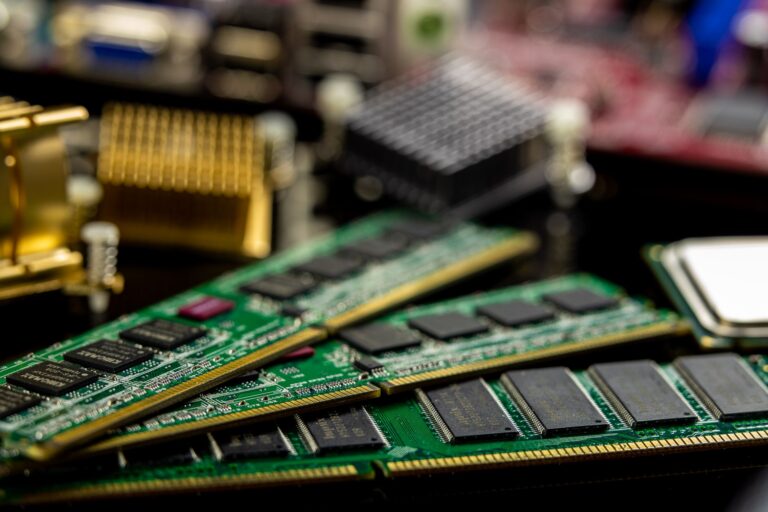
CXL Memory enables the expansion of CPU memory on compatible servers beyond the capacity limits of traditional RAM slots. When the maximum supported local DDR5 memory capacity of an AI server is reached and memory-intensive AI workloads require additional memory, CXL Memory Expansion offers a possible solution.
CXL (Compute Express Link) is a PCIe-based interconnect standard through which additional memory capacity can be provided. Unlike traditional server RAM, CXL memory modules or memory expansion devices are connected through compatible CXL links rather than through the CPU’s direct DIMM memory channels. This allows the CPU-addressable system memory to be expanded without requiring additional RAM slots. CXL RAM thereby complements local DDR5 memory but does not fully replace it due to differing latency and bandwidth characteristics.
This article explains what CXL Memory is, how memory expansion works, what differences exist compared to traditional server RAM, and which AI workloads can benefit from it. You will also learn which server platforms support CXL and under which conditions CXL Memory Expansion can be worthwhile for memory-intensive applications, from the perspective of our server experts.
What Is CXL Memory and How Does It Attach to the System?
CXL Memory is not a new type of DRAM chip. It is memory accessed through the Compute Express Link protocol – a cache-coherent interconnect standard running over compatible PCIe-based connections. While traditional DDR5 memory modules plug into dedicated DIMM slots connected directly to the memory channels of the server CPU, CXL memory modules and expansion cards attach through CXL-capable PCIe slots or specialised form factors such as EDSFF E3.S. With appropriate platform support, they can be presented to the operating system as additional system memory. The CXL specification defines three protocol types. CXL.io handles I/O traffic, similar to standard PCIe. CXL.cache allows a device to cache host memory. CXL.mem – the type relevant for memory expansion – enables a host CPU to access memory on a CXL device using load and store semantics, using the intended coherency mechanisms between host and CXL device.
This memory access architecture distinguishes CXL Memory from a block storage device or a GPU’s local HBM: the CPU can access CXL-attached memory as system memory without requiring explicit DMA transfers at the application level. However, provisioning requires appropriate firmware and operating system support. For CXL Memory Expansion, Type 3 CXL devices are used in particular. These are memory expanders – add-in cards or modules that provide memory capacity but no compute capability of their own. They connect through compatible CXL links and present their DRAM to the host. Type 2 devices, by contrast, combine compute acceleration with device-side memory. Pure memory expansion is based on Type 3.
How CXL Memory Differs from Traditional Server RAM
The architectural difference between CXL Memory and DDR5 RDIMMs lies in the access path. DDR5 memory sits on dedicated channels directly connected to the CPU’s integrated memory controller. On Intel Xeon 6 or AMD EPYC 9005 platforms, multiple DDR5 memory channels per socket are available, together delivering theoretical memory bandwidth of several hundred gigabytes per second. The supported data rate and the actually achievable bandwidth depend on processor, DIMM type, population, and server platform. CXL RAM, by contrast, attaches through a compatible PCIe-based connection and typically exhibits higher access latencies than local DDR5 RAM. Even over PCIe 5.0 x16 links – which provide theoretical transfer bandwidth of around 63 GB/s per direction – the additional access path introduces higher latency. Actual access times depend on the CXL device, platform topology, possible CXL switches, and access pattern. A universally valid nanosecond range cannot therefore be established.
Bandwidth also behaves differently. While multiple DDR5 memory channels can be used in parallel, CXL memory bandwidth is constrained by PCIe link width and the number of devices sharing the available connection. A CXL memory expander on a single PCIe 5.0 x16 link has theoretically around 63 GB/s per direction. With an x8 connection, this theoretical link bandwidth is halved. The actually usable memory bandwidth can be lower due to protocol overhead and device characteristics. CXL Memory therefore does not replace DDR5 RDIMMs but extends the available memory capacity with an additional memory tier. Applications with frequent random memory access benefit from keeping their working set in local DDR5 RAM. CXL Memory, by contrast, is suited as a capacity tier for less frequently accessed data, provided their access pattern tolerates the higher latency and limited bandwidth. This can include large lookup tables, graph datasets, or certain in-memory database partitions.
Which Server Platforms Support CXL Memory Expansion?
CXL Memory Expansion requires a CPU with CXL support, a motherboard with appropriate CXL-capable PCIe connections, and BIOS firmware that can recognise CXL devices and present them to the operating system as memory regions. Not every server with PCIe 5.0 slots automatically supports CXL Memory. The respective connections must be CXL-capable, and the platform must provide the required functionality including memory description through appropriate firmware and ACPI structures. Intel introduced CXL support with 4th Gen Xeon Scalable (Sapphire Rapids) and continued it through 5th Gen (Emerald Rapids) to the Xeon 6 generation. AMD added CXL support starting with EPYC Genoa (9004), extended in AMD EPYC Turin (9005). Intel Xeon Scalable 4th and 5th generation support CXL 1.1, while Xeon 6 supports CXL 2.0. For AMD EPYC, the available CXL feature set depends on the respective processor generation and platform implementation.
Support for a CXL version does not automatically mean that all features for CXL Memory Expansion or CXL Memory Pooling are available. Platform support is not uniform. GIGABYTE, for example, offers the R284-S91-AAJ2, an Intel Xeon 6-based server with eight E3.S 2T bays for CXL memory expansion modules. The server R263-ZG5-AAL2 (Rev. 3.x) supports AMD EPYC 9005/9004 and features four E3.S 2T bays for CXL Memory Expansion as well as one PCIe 5.0 slot for a GPU. For other server manufacturers, too, support is limited to specific platforms and configurations.
Why Memory-Intensive AI Workloads Require Additional RAM Capacity
For AI servers, high memory demand does not arise exclusively from the size of the model being used. Training data, data pre-processing, model weights, intermediate results, and concurrently executed inference processes also consume memory resources. A distinction must be made between the host system’s memory and the GPUs’ local memory. While GPUs use their HBM or VRAM for processing models and data, the CPU memory provides capacity for data pipelines, CPU-based model computations, and provisioning of large data structures, among other things.
If this demand exceeds the maximum supported DDR5 capacity of an AI server, CXL Memory Expansion can provide additional CPU-addressable system memory. The prerequisite is a compatible server platform. This does not increase the capacity of the GPU HBM or VRAM. Whether GPU-accelerated applications benefit from the additional system memory capacity depends on data processing and the supported memory mechanisms of the AI software being used.
Which AI Workloads Benefit from CXL Memory Expansion?
CXL Memory is particularly interesting for AI applications where the available CPU RAM capacity limits processing of larger models or datasets. The decisive factor is how frequently the additionally provisioned memory regions are accessed and whether the application can tolerate their latency and bandwidth.
AI Inference: Large Language Models and CPU-Side Model Provisioning
For inference of large language models, memory is required for model weights, activations, and the KV cache, among other things. How this data is distributed across GPU memory and CPU memory depends on the inference framework being used and the hardware architecture. CXL Memory can provide additional capacity for CPU-based inference or CPU-side model components when the required data does not fit entirely in local DDR5 memory. For GPU-accelerated inference, however, this capacity is not automatically usable. When model weights or other data are transferred between CPU memory and enterprise GPU, the transfer paths and memory bandwidth can limit inference performance. Whether memory expansion offers an advantage must therefore be examined for the specific model size, quantisation, number of concurrent requests, and the framework’s memory management.
RAG and Vector Search: Large Indices in Memory
Retrieval-Augmented Generation (RAG) combines processing by a language model with search for relevant information in external data stores. Depending on the implementation, extensive vector indices, metadata, and other search structures can require considerable amounts of CPU memory. CXL Memory Expansion can provide additional capacity for such data structures when the available local RAM is insufficient. This is particularly interesting for large data stores whose memory demand exceeds the DIMM capacity of the platform. Performance, however, depends on the search algorithm and access pattern. Frequent, irregular memory accesses can be sensitive to additional latency. Therefore, it is not only the size of the vector index that matters but also which parts of the data structure remain in local DDR5 RAM and which are attached through CXL. For RAG servers, CXL Memory Expansion can therefore be sensible when large vector indices and metadata require more CPU memory than can be provided through the local DIMM slots.
AI Data Processing: Large Datasets and Memory-Intensive Pipelines
Even outside actual model computation, AI applications can exhibit high RAM demand. Data pre-processing, feature engineering, and machine learning workloads sometimes work with extensive datasets and temporary memory structures. CXL Memory can provide additional system memory capacity here when data processing would otherwise be limited by available RAM. A performance gain is not guaranteed, however: what matters is whether the additional memory capacity actually eliminates a capacity bottleneck or whether the application is primarily limited by memory latency or bandwidth.
When Is CXL Memory Sensible for an AI Server?
CXL Memory Expansion is not automatically the better alternative to additional DDR5 RDIMMs. Its use becomes relevant particularly when a compatible server platform has exhausted its supported local RAM capacity and the application still requires additional CPU memory. Four questions are decisive for technical evaluation:
- Is CPU RAM capacity actually the bottleneck? If instead GPU HBM, compute performance, or network bandwidth is limiting, CXL Memory does not directly resolve this bottleneck.
- Which data require particularly low access latencies? Frequently accessed memory regions should preferably reside in local DDR5 RAM. For less frequently accessed data, CXL RAM can be considered.
- Does the software support the required memory management? Depending on the platform, use occurs through NUMA memory regions, operating system mechanisms, or a hardware-managed memory hierarchy. Appropriate data placement is not automatically guaranteed.
- Is the specific server configuration compatible? CPU, motherboard, firmware, CXL memory modules or memory expansion device, and operating system must support the planned memory expansion.
A typical deployment scenario is a memory-intensive AI workload whose frequently accessed data still fit in local DDR5 RAM, while additional data structures can be held in CXL-attached memory.
When CXL Memory Fits the Workload
CXL Memory is particularly suited for workloads where available memory capacity is more limiting than memory bandwidth or access latency. In addition to the previously described AI applications, large in-memory databases and graph analytics workloads can also benefit from additional capacity. For latency-sensitive workloads with frequent random memory accesses, application performance can degrade if intensively used data reside in expanded memory. This affects, for example, certain database queries and HPC computations with memory-dependent processing steps. Such applications are not fundamentally unsuitable, however, provided appropriate memory placement is possible.
CXL Memory Pooling differs from memory expansion of a single server. While CXL Memory Expansion provides additional capacity for one host, CXL Memory Pooling enables the allocation of compatible memory resources to different hosts through an appropriate CXL switch infrastructure. Dynamic provisioning requires corresponding hardware and software support. This does not mean that multiple hosts can readily share the same memory region concurrently without further measures. When the supported local DDR5 capacity has not yet been exhausted, expansion through additional DIMMs is often the technically simpler solution with lower access latency. CXL becomes interesting particularly when this expansion option reaches its limits or when a CXL-based memory architecture offers additional technical or economic advantages.
Dimensioning CXL Memory Expansion by Capacity Need and Latency Tolerance
For dimensioning a CXL memory expansion, three variables are decisive: the additionally required memory capacity, the application’s latency sensitivity, and the maximum supported expansion capacity of the specific server platform. Example: If an AI workload requires 8 TB of CPU memory and the server platform supports a maximum of 6 TB local DDR5 RAM, an additional capacity requirement of 2 TB results. Whether this can be met through CXL Memory Expansion depends on the supported device configuration and expansion capacity.
First determine the working set size – the portion of memory that is accessed frequently – and compare it to the available DDR5 capacity. If the working set fits in local RAM while less frequently accessed data additionally need to be stored, CXL Memory can be suitable for this data. Then measure latency sensitivity. Profile the application’s memory access pattern: what percentage of memory operations are random versus sequential accesses, and how much time does the application spend waiting on memory?
Workloads with many small random read accesses – for example, certain key-value stores – can be slowed by higher CXL latency. Applications with large sequential accesses can benefit from prefetching but remain limited by available CXL memory bandwidth. Actual effects should be measured using representative workloads. For economic evaluation, in addition to memory price, CXL memory modules, expansion cards, possibly switches, and integration effort must also be considered. CXL Memory also consumes PCIe resources that could otherwise accommodate GPUs, network adapters, or NVMe storage.
Especially for new technologies such as CXL Memory, technical compatibility is decisive. Not every server platform supports CXL Memory Expansion. For planning, processor, motherboard, BIOS firmware, PCIe connection, and operating system must be considered, among other things. Equally important is the question of whether the respective workload actually benefits from additional RAM capacity.
At Server-Hardware.com, you can buy servers and select suitable server RAM components. Our server experts advise you on selecting an appropriate memory architecture and examine with you the requirements for capacity, performance, and expandability. Whether a CXL-based RAM expansion is feasible depends on the specific platform and the available manufacturer approvals.
CXL Memory: When Capacity Expansion Justifies the Latency Trade-Off
CXL Memory extends the CPU-addressable memory capacity of compatible servers beyond the supported local DDR5 configuration. The additional capacity, however, comes with higher access latencies, limited bandwidth, and additional platform complexity. For memory-intensive AI workloads, CXL Memory Expansion thus offers a way to expand CPU memory when traditional RAM expansion is no longer sufficient. The technology does not, however, increase local GPU HBM and does not guarantee higher application performance.
Whether CXL Memory is worthwhile depends on whether the capacity gain justifies the additional latencies, limited bandwidth, and integration effort. The decisive factors are the specific server platform, memory access patterns, and economics.
Technical sources:

 Online Marketing Manager