Retrieval-Augmented-Generation servers combine vector search with large language model inference to deliver contextually accurate answers grounded in enterprise-wide knowledge bases. The architectural split between retrieval and generation creates specific requirements for RAG servers that differ sharply from standard LLM hosting or database workloads. A RAG deployment must handle concurrent vector similarity searches across millions of embeddings, generate fresh embeddings for incoming queries, optionally rerank results, then feed the retrieved context into an LLM for final answer generation – all within acceptable latency bounds for interactive use. When planning a RAG server, the hardware question facing infrastructure teams is not whether RAG needs compute resources, but how memory bandwidth, storage I/O, CPU core count and GPU allocation translate into query throughput and response latency at the user counts the organisation actually expects. A single-server configuration sized for ten concurrent users can hit its performance limits at fifty concurrent users; a GPU SKU chosen for a 7B parameter model does not necessarily have sufficient VRAM to run a 70B model. The central difficulty is that vendor reference architectures state what components their test environments used, but do not establish universal minimum specifications for every query load.
This article establishes what each RAG pipeline component demands from a RAG server, which specifications determine throughput and latency, and how to size a configuration against concurrent query volume rather than total employee count.
How RAG Architecture Determines Server Requirements
A production RAG server comprises five distinct components, each with its own resource profile. Requirements for a RAG server arise from the distribution of resources among these components. The embedding model converts user queries and knowledge base documents into dense vector representations. The vector database stores these embeddings and executes similarity searches to retrieve the most relevant passages. The reranker optionally refines retrieval results using a second, more precise model. The LLM receives the retrieved context and generates the final answer. The orchestration layer coordinates these steps and manages prompt construction. NVIDIA’s Enterprise RAG Deployment Guide explicitly separates these workloads because their hardware dependencies differ. Embedding generation is CPU- or GPU-bound depending on model size and query rate. Vector search is limited by memory, CPU performance and potentially storage I/O, depending on the database and index architecture used. Reranking behaves like embedding but runs on smaller batches. LLM inference is GPU-memory-bound and compute-bound. Orchestration is lightweight. Conflating these into “RAG needs GPUs” or “RAG needs fast storage” obscures the actual decision: which components run on shared hardware, which require dedicated nodes, and where resource contention creates the first bottleneck.
A RAG deployment can run all components on a single RAG server, provided sufficient CPU performance, memory, storage resources and potentially GPU performance are available for the models deployed and the expected number of queries. This configuration works where concurrent query volume stays within the performance limits of the system and where sufficient memory and potentially GPU memory are available for the vector database deployed and the models. As query volume grows, splitting the workloads across specialised nodes may become necessary to maintain the target retrieval latency and token generation speed. Scaling follows the actual performance bottlenecks and latency requirements. A RAG server is not a standalone server type with specially developed hardware, but a server system designed to run Retrieval-Augmented-Generation applications. Organisations can run the required software components on an existing AI server, provided sufficient CPU performance, memory, storage and potentially GPU resources are available. Alternatively, the RAG components can be run on a separate server system, while the existing AI server continues to handle LLM inference. A dedicated RAG server is particularly useful when the vector database, embedding processing and retrieval are to be operated or scaled independently of LLM inference.
What Advantages Does a RAG Server Offer?
A RAG server enables organisations to make internal knowledge sources usable for AI-assisted applications. By combining information retrieval with generative AI, answers can be grounded in current, organisation-specific documents and data.
- Access to internal company knowledge: Documents, technical manuals, knowledge bases and other information sources can be included in answering user queries.
- Updatable knowledge base: New or changed information can be incorporated by updating document collections and search indices, without having to retrain the language model.
- Traceable answers: Retrieved documents and text passages can be provided as source references, allowing users to verify the information used.
- Fewer unsupported answers: Providing relevant information can reduce the risk of hallucinations, provided retrieval quality and answer generation are appropriately designed.
- Control over sensitive company data: In a local RAG deployment, documents, search indices and processing can remain within the organisation’s own IT infrastructure. Access rights and security policies can be integrated into the application.
- Scalable AI applications: Compute performance, memory, storage and potentially GPU resources can be dimensioned according to the size of the knowledge base, the number of concurrent queries and the requirements for response latency.
Why RAG Servers Require High Memory Bandwidth
Vector databases on RAG servers can keep embedding indices entirely in memory to enable fast vector similarity searches without additional storage accesses. A knowledge base of 10 million embeddings with a 768-dimensional model produces approximately 30 GB of vector data before index overhead at FP32 storage. HNSW indices use graph-based search structures, while IVF-PQ partitions the search space and compresses vectors to reduce memory requirements. Searching HNSW indices requires irregular memory accesses when traversing the graph, while IVF-PQ limits the number of vectors to examine through a pre-selection of partitions.
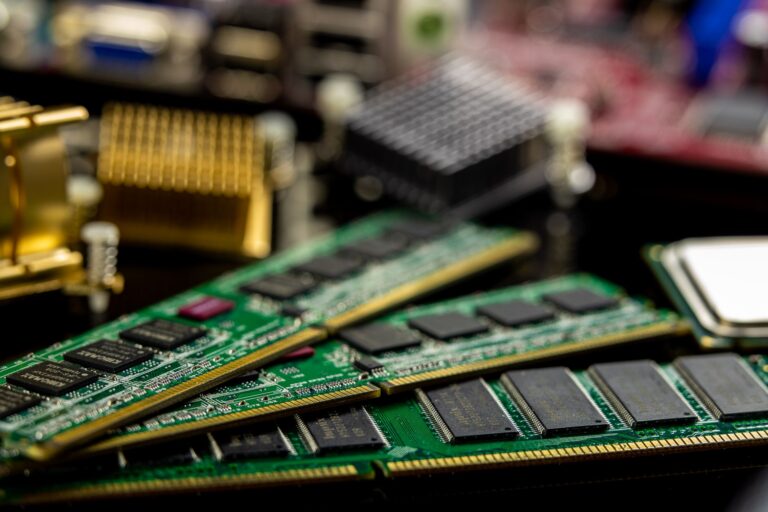
DDR5-5600 achieves a theoretical bandwidth of 44.8 GB/s per memory channel, compared to 25.6 GB/s for DDR4-3200. That represents a 75% higher theoretical channel bandwidth. This difference matters where query volume pushes retrieval into a regime where multiple searches run concurrently and the vector database cannot keep the entire working set in L3 cache. Memory capacity requirements scale with document count and embedding dimensionality. A knowledge base of 50 million embeddings at 1024 dimensions requires approximately 204.8 GB (190.7 GiB) at FP32 storage for embeddings alone, plus memory for the index structure used and metadata. Operating systems, orchestration layers and the embedding model runtime claim additional capacity. For a fully memory-resident configuration with 50 million FP32 vectors, a RAM configuration above the pure 205 GB of vector data is therefore required. 384 GB or 512 GB RAM can be sensible starting configurations for RAG servers, provided the memory requirements of the chosen index method are taken into account. DDR5 RDIMM at 5600 MT/s or higher offers high theoretical memory bandwidth for memory-intensive search methods and parallel retrieval queries.
Storage Architecture for RAG Servers and Vector Databases
Vector databases place two distinct I/O demands on the storage of a RAG server. Index construction during initial ingestion and periodic reindexing can generate extensive read and write operations. Query-time retrieval reads small, scattered blocks in storage-based index methods as the search algorithm traverses the index graph. Both patterns benefit from NVMe, but for different reasons: data-intensive write operations benefit from the high sequential transfer rate of modern server NVMe SSDs, while storage-based search methods can exploit their low random read latencies. With fully RAM-resident indices, however, the actual vector search occurs without drive-based index accesses.
RAG servers in on-premise deployments running Milvus, Weaviate or Qdrant can use NVMe SSDs for persistent vector data, index files and database-internal write operations. Depending on the database and index method, search data can also be kept on SSDs if not stored entirely in RAM. Even where the active index fits in RAM, the vector database persists data to persistent storage for durability and writes updated embeddings as documents are added. A RAID array of enterprise server SSD drives provides both high I/O performance for data-intensive database operations and the write endurance for continuous ingestion. Four enterprise NVMe SSDs in RAID 10 can form a high-performance storage configuration. The actually achievable random read IOPS are determined by the SSDs used, the RAID implementation, block size and queue depth, however. Where the knowledge base exceeds what local NVMe arrays can economically accommodate, or where multiple RAG nodes must access a shared document corpus, a dedicated NAS server provides centralised storage for shared documents and suitable persistent datasets. Network-attached storage trades single-node NVMe latency for capacity and manageability at scale, while latency-critical database components can continue to run on local NVMe storage.
When CPU-Only Configurations Suffice for RAG
Smaller embedding models – those with fewer than 400 million parameters – and lower query volumes permit RAG servers without GPU. A dual-socket server with 64 to 96 cores can be used as a high-performance CPU platform for embedding generation with optimised ONNX or TorchScript runtimes. The achievable query rate is determined by model size, input length and CPU utilisation in particular. The LLM component can run on the same CPUs if the model is quantised to 4-bit or 8-bit precision and sufficient memory for model weights and KV cache is available. Llama 3.1 8B at 4-bit quantisation computationally requires approximately 4 GB for the pure model weights. The actual RAM requirement is higher due to additional quantisation data, the KV cache and the runtime environment.
The advantage of CPU-based RAG servers is deployment simplicity: no GPU driver management, no CUDA version dependencies, no PCIe lane allocation conflicts. The disadvantage is scaling: additional CPU inference capacity can be provided through additional CPU resources or additional server nodes. For high inference throughput, however, suitable GPUs frequently offer higher compute performance and memory bandwidth than CPU-based configurations. CPU-based RAG works where the organisation already operates x86 infrastructure, where GPU procurement timelines or budgets are prohibitive, and where query volume is predictable and moderate. With larger language models, frequent reindexing with compute-intensive embedding models, or high parallel query counts, GPU acceleration can provide the required inference and embedding performance. However, there is no fixed model size threshold of eight billion parameters above which GPUs become mandatory.
GPU Requirements for RAG Servers and LLM Inference
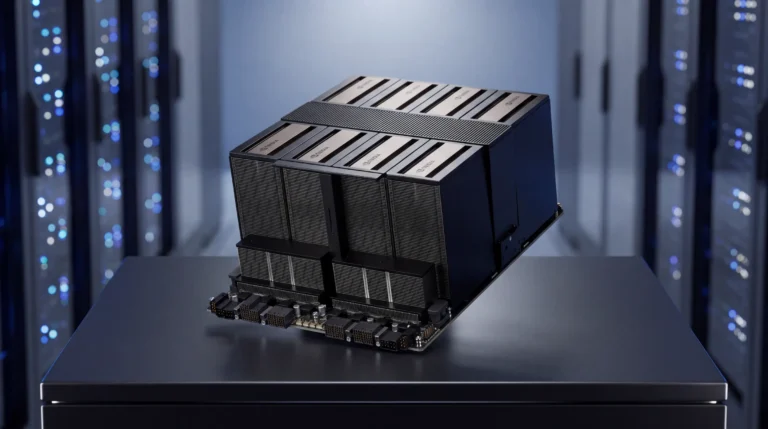
LLM inference in a RAG server differs from batch processing or fine-tuning: each query arrives independently, waits for retrieval to complete, then expects token generation to start with the lowest possible time to first token (TTFT). For latency-critical inference, it is advantageous to keep the actively required model weights in GPU memory. CPU offloading and distribution across multiple High-End GPUs can introduce additional data transfers or communication overhead respectively. The LLM must fit with its actively required model weights and runtime data in the available GPU memory, unless deliberately configured offloading is used. Additional memory is required for the KV cache, whose size grows with context length and the number of parallel sequences in particular. A 13-billion-parameter model quantised to 4-bit precision computationally requires approximately 6.5 GB for the pure model weights; in practice, quantisation metadata, KV cache and runtime overhead are added. A 70-billion-parameter model at the same precision computationally requires approximately 35 GB for the pure weights. The additional KV cache requirement depends on model architecture, context length, batch size and cache precision. These figures determine the minimum GPU: an RTX 6000 Ada with 48 GB may be suitable for a correspondingly quantised 70B model if model weights and runtime data including KV cache fit in the available VRAM; an H100 with 80 GB offers more GPU memory for larger context windows and parallel queries. NVIDIA Multi-Instance GPU (MIG) enables the partitioning of supported GPUs into mutually isolated GPU instances, but is not available on every GPU.
On a RAG server with shared GPU resources, LLM, embedding and reranking requests compete for compute performance and memory bandwidth. NVIDIA dimensions inference performance based on requests per second, token throughput, time to first token and other latency metrics. With longer contexts, the memory requirements of the KV cache increase and processing additional input tokens increases the prefill load in particular. Where query volume exceeds what one GPU delivers, or where specified response latencies cannot be maintained during peak load, the RAG server requires additional inference capacity, for example through additional GPUs with load balancing or distribution of inference services across multiple server nodes. Embedding and reranking workloads can be executed on separate GPUs or proportional GPU resources. NVIDIA describes in its Enterprise RAG reference architecture, for example, an allocation of 0.5 GPU for the embedding NIM service and a full GPU for the reranking NIM service. LLM inference is operated as a separate service. Distributing these workloads across different GPU SKUs enables targeted resource allocation and can prevent high-performance LLM accelerators from being additionally loaded by embedding or indexing tasks.
Sizing RAG Servers for Internal AI Assistants: Query Load and Model Requirements
When sizing a RAG server, concurrent query volume determines hardware scale, not total employee count. An organisation with 500 employees does not require a 500-user RAG infrastructure if peak concurrency stays below fifty. Profiling the access pattern – whether queries arrive in bursts during business hours or spread evenly, whether users expect instant responses or tolerate 3–5 second latency, whether the knowledge base updates hourly or monthly – produces the utilisation curve that translates into CPU cores, RAM capacity, NVMe drive count and GPU allocation. The chosen LLM sets the lower bound on GPU VRAM for a RAG server. A 70B model computationally requires approximately 35 GB for the pure model weights at 4-bit quantisation, while a 13B model at the same precision requires approximately 6.5 GB. Additional GPU memory is required for quantisation metadata, KV cache and the runtime environment. The required VRAM capacity also depends on context length and parallel queries. The embedding model determines whether CPU-based generation suffices or whether a dedicated embedding GPU reduces latency under load. The vector database size determines DDR5 capacity and whether the index can stay memory-resident or whether a memory-based or storage-backed index method is required. Each specification answers to a measured workload characteristic, not to a vendor-supplied reference configuration.
From our experience in planning and integrating custom server systems, we recommend considering the requirements of a potential RAG architecture already when purchasing new AI servers. This allows CPU, RAM, GPU and storage resources to be aligned early on for the joint operation of AI inference, embedding models and vector databases. Existing AI infrastructures can also be extended with RAG functionality retrospectively, for example through a dedicated RAG server that handles retrieval and data processing, while the existing AI server continues to execute LLM inference. Server-hardware.com provides Build-to-Order and Configure-to-Order platforms for RAG servers, where IT architects specify the exact CPU, RAM, GPU and storage combination their RAG deployment requires. Compatibility questions – whether a given motherboard supports four dual-slot GPUs, whether 512 GB DDR5 fits across twelve channels, whether twelve NVMe drives can coexist with two GPUs in a 2U chassis – are answered directly by server specialists before purchase. Project quotations account for volume discounts and extended warranty terms up to six years, supporting the multi-year operational planning RAG infrastructure investments require. Explore the available servers or contact our team for configuration guidance.
Technical sources:

 Online Marketing Manager