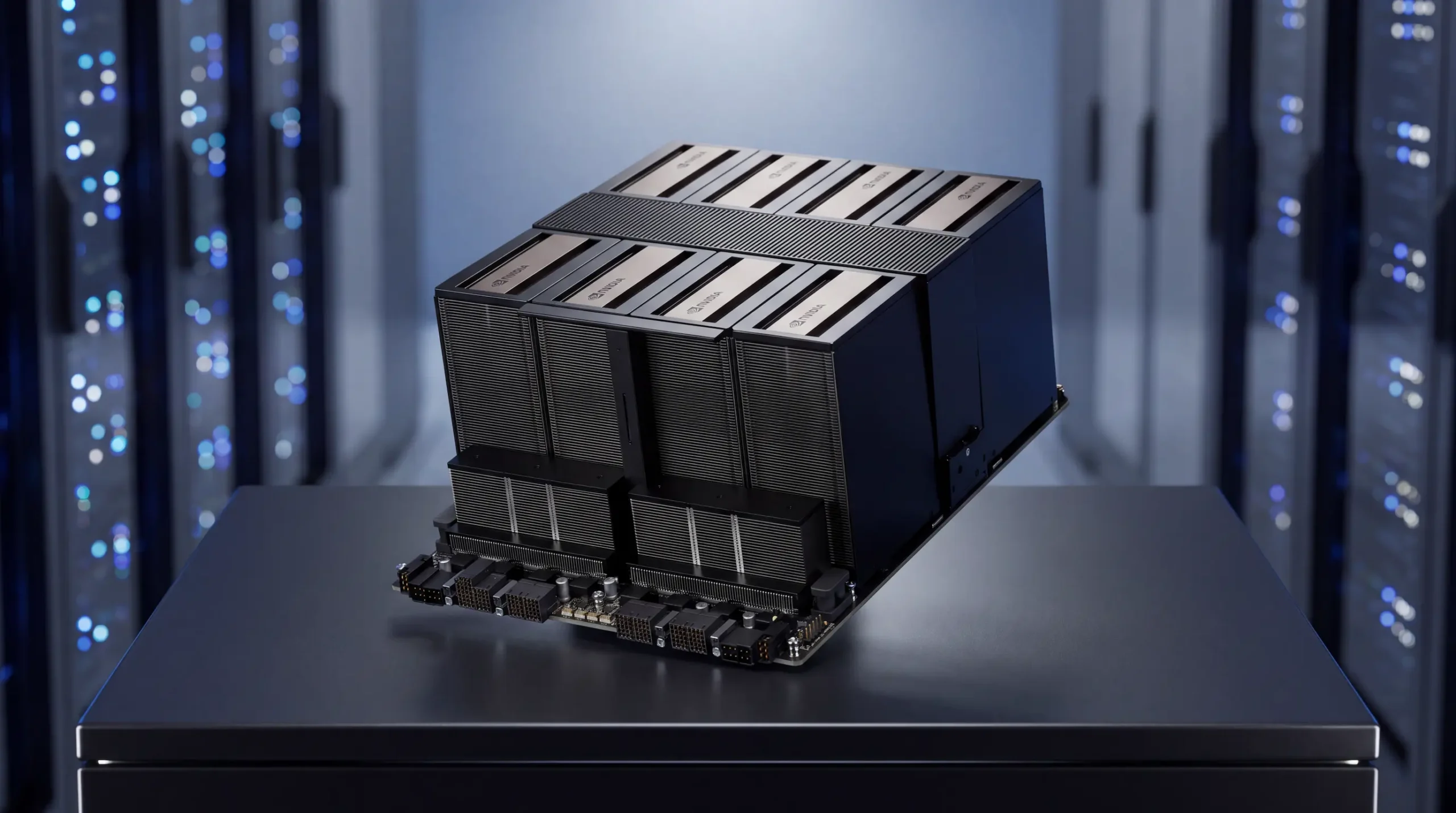
B300 servers are GPU-accelerated server systems for compute-intensive AI workloads, particularly the training of large language models, distributed deep learning and AI inference. A central hardware platform is NVIDIA HGX B300 with eight Blackwell Ultra GPUs connected via fifth-generation NVLink and NVSwitch. The HGX B300 module forms the GPU compute platform and is complemented by host processors, system memory, NVMe storage, network adapters and power supply and cooling infrastructure to create a complete server.
When selecting a B300 server, organisations distinguish between the fully integrated NVIDIA DGX B300 and validated HGX B300 servers from OEM manufacturers. The respective server systems differ with regard to CPU architecture, PCIe topology, memory and I/O capacity, network fabric, thermal design and system validation.
This article explains the architecture and hardware requirements of B300 servers, compares the different system approaches and shows which configurations are suitable as AI servers for production AI workloads and scalable data centre infrastructures.
What Does B300 Server Mean in Practice?
The term “B300 server” generally refers to complete server systems built around the NVIDIA HGX B300 GPU compute module. The NVIDIA HGX B300 platform is not a standalone server – it is a baseboard featuring eight NVIDIA Blackwell Ultra GPUs, an NVLink 5 interconnect fabric, and an integrated NVSwitch topology. A fully operational B300 server requires host CPUs, system memory, storage, networking, power supplies, and thermal infrastructure assembled around this module.
Complete server systems based on NVIDIA HGX B300 are offered by both NVIDIA itself and OEM manufacturers:
- NVIDIA DGX B300: turnkey NVIDIA complete system.
- OEM HGX B300 servers: complete systems from server manufacturers that can be individually configured within the supported platform configurations.
Procurement decisions therefore start by determining whether a validated turnkey platform or a specific OEM configuration delivers the required performance, support model and commercial terms. NVIDIA HGX B300 servers with eight Blackwell Ultra GPUs connected via NVLink and NVSwitch are architecturally distinct from systems based on the NVIDIA GB300 Grace Blackwell Ultra Superchips.
B300 Server: Architecture and System Requirements
Understanding what the HGX B300 contributes – and what it requires from the host system – determines which B300 server configurations are viable. The HGX B300 module integrates eight NVIDIA Blackwell Ultra GPUs with 288 GB HBM3E memory each, connected via fifth-generation NVLink at 1.8 TB/s bidirectional bandwidth per GPU. The NVSwitch fabric connects the eight GPUs via a high-bandwidth interconnect topology and enables efficient GPU-to-GPU communication for distributed training and inference workloads.
Host platform requirements scale with the workload:
- CPU selection: HGX B300 servers use, for example, two AMD EPYC 9004/9005 or Intel Xeon 6 processors depending on the OEM platform. The CPU selection must meet the requirements for host compute, memory bandwidth and PCIe connectivity in particular.
- Memory capacity: the NVIDIA reference architecture for certified HGX B300 servers specifies at least 2 TB host memory. The actually supported capacity and memory configuration depend on the respective OEM platform.
- NVMe storage throughput: the number and capacity of server NVMe SSDs depend on the workload and storage architecture. GIGABYTE HGX B300 servers of the G894 series offer, for example, eight 2.5-inch bays for PCIe Gen5 NVMe SSDs. Whether local NVMe storage is sufficient for continuous dataset streaming depends on the required data rate and the integration of external storage systems.
- Network fabric: HGX B300 servers such as the GIGABYTE G894 series integrate eight NVIDIA ConnectX-8 SuperNICs with up to 800 Gb/s per adapter for InfiniBand XDR or Ethernet. The required network bandwidth depends in particular on the number of cluster nodes, the communication volume and the parallelisation strategy used.
An HGX B300 server must therefore be dimensioned as a complete system. In addition to GPU performance, the host memory configuration, local and external storage throughput and network topology in particular determine which training and inference workloads can be executed efficiently.
Which CPU Platform Fits B300 Servers?
The host CPU determines PCIe lane allocation, memory subsystem performance, and platform longevity. Current HGX B300 servers are available with the following host CPU platforms, among others:
AMD EPYC 9005 platforms: dual-socket configurations with AMD EPYC Turin 9005 provide extensive PCIe and memory resources. However, which connections are available for NVMe storage, network adapters and expansion cards is determined by the specific OEM platform including its PCIe switch topology. DDR5-6400 can support memory-intensive host workloads; the actually achievable performance depends on memory population and the respective workload.
Intel Xeon 6 platforms are also used in HGX B300 servers. The supported processor variants differ depending on manufacturer and server model: Supermicro uses Intel Xeon 6700 with P-cores in the SYS-822GS-NB3RT, while GIGABYTE also supports selected Xeon 6 processors with E-cores in the G894-SD3-AAX7. Critical for platform selection are the approved CPU models, the memory architecture and the PCIe topology of the respective server.
The validated HGX B300 servers from GIGABYTE are designed as dual-socket systems. When populated with only one processor, certain PCIe or memory functions may not be available according to the manufacturer. The decision on CPU population must therefore be made based on the specific server architecture and supported configurations.
Platform selection depends on existing infrastructure standards, vendor relationships and licensing models. An organisation with AMD-based clusters gains operational consistency by continuing with EPYC; one committed to Intel software optimisations chooses Xeon. Which CPU platform is suitable for an HGX B300 server depends not only on the supported OEM configurations but also on host workloads, existing infrastructure standards and operational requirements.
Storage Configuration for B300 Servers by Deployment Scenario
Storage requirements diverge sharply between training and inference deployments.
Training-Optimised B300 Server Storage: Distributed training consumes datasets continuously. Batch sizes in the hundreds of samples per GPU demand sustained sequential read throughput that hard drives cannot deliver. A training configuration requires a storage architecture aligned with dataset size, access pattern and data rate. Local PCIe Gen5 NVMe SSDs can be used for dataset caching and temporary training data. Number, capacity and RAID configuration depend on the respective OEM platform as well as the requirements for throughput and data availability. Checkpoints and model state should be saved regularly to persistent storage according to the recovery strategy. The backup interval depends on workload, checkpoint size and tolerable compute time loss.
Inference-Optimised B300 Server Storage: Inference serving typically loads model weights into GPU memory and then processes requests. Storage is needed in particular for model deployment, model switching, versioning and, where applicable, reloading of data. The number and capacity of NVMe SSDs depend on model size, loading times and data access patterns. Write-intensive logging or persistence workloads require appropriately rated SSD endurance.
Network Fabric for Multi-Node B300 Server Clusters
Single B300 servers operate standalone for inference or small-scale training. Clusters require backend networking:
Ethernet or InfiniBand: HGX B300 servers can be connected via high-performance Ethernet or InfiniBand fabrics for distributed AI workloads. GIGABYTE supports, for example, InfiniBand XDR with up to 800 Gb/s or dual 400 GbE via ConnectX-8. Ethernet configurations can use RoCE for RDMA communication. The selection depends on cluster architecture, required communication performance and existing network infrastructure.
Multi-rail configurations use multiple network connections to distribute communication load and increase available bandwidth. Redundancy and fault tolerance depend on the specific network and switching topology.
Thermal Design and Power Delivery for B300 Servers
HGX B300 servers exhibit high power consumption due to their eight Blackwell Ultra GPUs. NVIDIA specifies around 14 kW for the complete DGX B300 system. The actual power consumption of an OEM server depends on GPU power profile, host processors, memory, networking and other components. Power delivery and cooling must be dimensioned based on the specific manufacturer specifications.
Cooling Architecture
Air-cooled HGX B300 servers require appropriately dimensioned airflow and suitable rack and data centre cooling. The permissible inlet temperatures and airflow requirements can be found in the specifications of the respective OEM system. GIGABYTE specifies an operating temperature range of 10 to 30 °C for the G894-ZD3-AAX7, for example.
Liquid cooling can support the removal of high heat loads and enable higher rack power densities. How much heat is removed via the coolant circuit depends on the respective system architecture and the liquid-cooled components. For liquid cooled servers or direct-to-chip solutions, suitable coolant supply including the necessary distribution and monitoring technology is required.
Power Supply Sizing and Redundancy
HGX B300 servers use manufacturer-dependent power supply architectures with multiple high-performance power supplies. For example, GIGABYTE integrates twelve 3,000 W power supplies in the G894-ZD3-AAX7, while Supermicro uses six 6,600 W power supplies in a redundant 3+3 configuration in the AS-8126GS-NB3RT. The actually available power and complete redundancy depend on system configuration, input voltage and utilisation.
OEM HGX B300 Servers
OEM HGX B300 servers are available in different configurations and can be customised to meet individual requirements within the configuration options supported by the manufacturer.
OEM HGX B300 Server Systems: Server manufacturers integrate the HGX B300 module with validated host platforms, firmware and support. Benefits include pre-validated hardware compatibility and thermal profiles, manufacturer-specific support and service options, and firmware and BIOS versions tailored to the respective server system. Total costs depend on the system configuration, integration effort, scope of support and procurement terms. Validated OEM systems reduce the effort required for in-house hardware integration and provide defined support and maintenance processes.
Customer-Configured HGX B300 Servers: Enterprises and data centres can configure HGX B300 servers based on suitable OEM platforms to meet their workload requirements. Within the configuration options supported by the manufacturer, they can, for example, select supported host processors and configure system memory and NVMe SSDs according to the manufacturer’s specifications. The available options are subject to the technical requirements of the respective server platform. In particular, the chassis, cooling architecture, power supply and firmware compatibility must be matched to the HGX B300 module and the overall system. The selected configuration must comply with the manufacturer’s requirements. Compatibility and availability of the desired components should be verified before ordering.
Server-hardware.com has many years of experience in configuring, integrating and deploying high-performance GPU servers for professional AI and HPC infrastructures. From numerous realised customer projects, our server experts know the requirements for aligning GPU architecture, CPU platform, PCIe topology, memory connectivity, network fabric and power supply and cooling. This practical experience flows into the technical planning, dimensioning and integration of individual B300 servers based on the NVIDIA HGX B300 platform.
Management, Monitoring and Remote Administration of B300 Servers
HGX B300 servers have multiple management and monitoring interfaces. The baseboard management controller (BMC) enables hardware-side remote administration, for example via Redfish or IPMI. GPU telemetry, health monitoring and diagnostics can be performed via NVIDIA Data Center GPU Manager (DCGM). For higher-level cluster management, additional software solutions such as NVIDIA Base Command Manager can be deployed. Central monitoring must consolidate the relevant data from host system, GPUs, NVLink/NVSwitch, networking and other infrastructure components. Which interfaces and management functions are available depends on the OEM system and the software deployed. OEM systems typically deliver integrated dashboards that consolidate both management planes.
When to Deploy NVIDIA DGX B300 Instead of Other B300 Servers?
The NVIDIA DGX B300 is a complete server system validated by NVIDIA with eight Blackwell Ultra GPUs, two Intel Xeon Platinum 6776P processors, 2 TB memory as standard, NVMe storage and an integrated NVIDIA software stack. It is delivered validated and fully supported by NVIDIA. DGX B300 offers a system architecture validated by NVIDIA with defined software and support services. OEM HGX B300 servers can, depending on configuration, software stack and support model, represent an alternative to DGX B300. Performance and total costs must be evaluated based on comparable system configurations and specific workloads.
NVIDIA HGX B300, DGX B300 and GB300 NVL72: What Is the Difference?
NVIDIA uses the designations HGX B300, DGX B300 and GB300 NVL72 for different system architectures. While HGX B300 designates the eight-GPU baseboard, DGX B300 is a complete server system developed by NVIDIA based on this platform. GB300 NVL72, however, is a rack-scale architecture with 72 Blackwell Ultra GPUs and 36 Grace CPUs connected via a shared NVLink network. When procuring, a clear distinction should therefore be made between individually configured HGX B300 servers, NVIDIA DGX B300 complete systems, multi-node clusters and GB300 NVL72 rack-scale systems.
Selecting the Right B300 Server Configuration for Production AI Workloads
In our view, the choice between NVIDIA DGX B300 and OEM HGX B300 servers depends on operational priorities, budget and deployment scale.
Prefer DGX B300 where: turnkey deployment, unified support and pre-validated performance matter more than component cost; AI team capacity is focused on model development rather than infrastructure tuning; vendor relationship with NVIDIA simplifies procurement.
Prefer OEM HGX B300 systems where: existing server vendor relationships provide commercial and support advantages; internal IT manages multi-vendor infrastructure routinely; validated configurations are required but component selection within the validated range is acceptable.
NVIDIA DGX B300 and OEM HGX B300 servers are based on the same GPU platform. However, differences in host processors, memory, storage, network connectivity, power profiles and software can affect actual workload performance.
Size B300 Servers According to the Workload
Selecting CPU count, memory capacity, storage throughput and network fabric for an HGX B300 server requires matching system resources to workload demands. Maximum supported capacity provides design headroom but does not define the economical configuration. Training workloads demand different balances than inference serving; multi-node clusters shift investment toward backend networking; single-node deployments require local or external storage connectivity aligned with the respective workload. Storage decisions depend on dataset size, access pattern and training batch size. Network adapter selection follows from whether the system operates standalone or participates in distributed workloads. Memory capacity scales with preprocessing pipeline complexity and multi-tenant inference concurrency. Power and cooling infrastructure must support not the idle state but sustained full-load operation.
At server-hardware.com we support organisations in selecting and configuring suitable HGX B300 servers. Our server experts advise system integrators, AI infrastructure teams and data centre operators on selecting the CPU platform, storage architecture, network fabric and cooling. Whether individual B300 servers or larger multi-system deployments: we support you with technical planning and provide individual quotations – including extended warranty and financing options.
Technical sources:

 Online Marketing Manager